Florida's tax lien system is governed by Chapter 197, Florida Statutes. When a property owner fails to pay real estate taxes by April 1st, the county Tax Collector is authorized to sell that delinquent tax obligation to investors in the form of a Tax Certificate. The investor who purchases the certificate effectively pays the outstanding taxes on behalf of the owner, and in return, receives a legal claim against the property bearing a statutory interest rate until the owner redeems the certificate.
Florida uses a bid-down-the-interest-rate system. Certificates open at the maximum statutory rate of 18% per annum. Competing investors bid the rate progressively lower. The investor willing to accept the lowest interest rate wins the certificate. This is the fundamental dynamic that separates Florida from premium-bidding states and creates the primary yield compression risk.
- The 5% Minimum Penalty Rule: Even if the winning bid is 0.25% (the statutory floor), the property owner must pay at least a 5% penalty upon redemption if the certificate was held for fewer than 12 months. This guarantees a meaningful floor return on short-held certificates even when bid wars drive rates to near-zero. After the first year, the face interest rate — however low — is what accrues.
- Auction Timing: Florida counties generally conduct their annual auctions in May and June, aligned with the state's delinquency processing calendar. The exact dates vary by county and are published 30+ days in advance on each county's tax collector website.
- Online Platform Infrastructure: Florida's 67 counties use third-party auction vendors — the two major statewide platforms are RealAuction.com and LienHub.com. Each requires separate registration, identity verification, and funding — plan your onboarding 4–6 weeks ahead of auction season. Always confirm which platform your target county uses directly on that county's Tax Collector website before registering.
- Post-Issuance OTC (Over-the-Counter) Sales: Certificates that receive no bids at the live auction — typically on problematic or low-value properties — are sold by the county at a fixed rate of 18% on a first-come, first-served basis post-auction. This is a strategically important channel for acquiring higher-yield paper that was simply overlooked.
- Certificate Lifespan: A Florida tax certificate is valid for a maximum of 7 years. If not redeemed and no Tax Deed Application is filed, the certificate cancels worthless. The investor must be proactive to protect their position.
Capital allocation in tax liens is not simply about yield-maximization — it is about risk-adjusted return on deployed capital. The nature and value of the underlying collateral determines both your redemption probability and your downside recovery path. A disciplined portfolio structure should stratify capital across risk tiers.
| Property Type | Suggested Allocation | Expected Yield Profile | Risk Notes |
|---|---|---|---|
| Owner-Occupied Residential (Homestead) | 40–50% | 1–8% blended | Highest redemption rate (85–95%). Owners are motivated to pay. Highly competitive at auction — rates bid to near-zero frequently. Safest collateral but lowest actual yield. |
| Non-Homestead Improved Residential Rentals, investment SFRs, condos |
25–30% | 5–14% blended | Good collateral, less bidder competition than homesteads. Owners may be landlords or investors who are financially stretched. Moderate redemption risk. Strong collateral base for eventual TDA. |
| Commercial / Industrial | 10–15% | 8–18% | Higher face amounts mean larger capital outlay. Environmental risk must be assessed. Less competitive bidding. Good risk/reward if due diligence is rigorous. |
| Vacant Residential Land | 10–15% | 5–18% | Lower redemption rate than improved. Must vet: buildability, wetlands, deed restrictions. Can be path to property acquisition at tax deed stage if desirable lot in growing area. |
| OTC / Leftover Liens | 5–10% | 18% (full statutory) | Maximum statutory yield, but there is a reason no one bid — thorough due diligence is mandatory before purchasing any OTC certificate. Avoid condemned, submerged, or HOA-encumbered lots. |
Avoid "sub-economic" parcels: Narrow strips of land, underwater lots, power-line easement slivers, and landlocked parcels have near-zero intrinsic value. Even at 18%, a lien on a $400 worthless lot is a capital trap — your TDA cost alone (filing fees, legal, title) will far exceed the property's value. Always verify minimum lot size for development, flood zone designation, and current use before bidding.
- Portfolio Minimum Size: Do not attempt a Florida tax lien portfolio below $50,000 in deployable capital. Certificate processing, due diligence, and TDA costs create substantial fixed overhead that does not scale down.
- Individual Certificate Size Sweet Spot: Target lien face values between $1,500–$25,000. Below $1,500: administrative burden is disproportionate. Above $25,000: concentration risk rises sharply and capital is tied up in a single position that may take 2–5 years to resolve.
- Diversification by County: Do not concentrate more than 25–30% of your portfolio in a single county. County-level flooding events, economic distress, or administrative changes can affect redemption rates across an entire book simultaneously.
Due diligence is the single most important lever in tax lien investing. A certificate on a worthless or heavily encumbered property is not a low-risk investment — it is a capital loss waiting to be formalized. This checklist should be applied to every parcel before you bid, without exception.
In tax lien investing, you are not buying the property — you are buying a secured debt obligation. Your security is only as good as the underlying collateral. A 18% rate means nothing if redemption never occurs and the property's auction value at the tax deed stage is less than your accumulated investment.
- Search the county Property Appraiser's website for assessed value, ownership, and parcel details — ensure the assessed value supports your lien amount by at least a 3:1 ratio
- Check the county Clerk of Courts for prior mortgages, judgments, and lis pendens — a first mortgage will survive a tax deed in many scenarios and can render your position unsecured
- Verify for any existing IRS federal tax liens (federal liens survive tax deeds in Florida and can attach to the new owner post-auction, creating catastrophic liability)
- Search for municipal code violations, building department liens, and outstanding permit issues — these can cloud title and suppress auction value
- Identify any existing HOA or CDD assessments that survive tax deeds — Florida HOA liens post-dating your certificate are senior in certain scenarios
- Check for multiple year tax delinquencies — if prior years are also liened, you may need to purchase all prior-year certificates to protect your position at TDA
- Verify FEMA flood zone designation — Zone A / Zone AE properties carry insurance costs that can suppress resale value and buyer pool dramatically. Use the FEMA Flood Map Service Center to confirm zone status by address.
- Check the Florida DEP OCULUS Database for brownfield designations, contamination notices, or Superfund proximity. Also cross-reference the EPA Cleanups in My Community tool for federal-level records.
- Identify any wetlands designation via FWS National Wetlands Inventory Mapper — wetland parcels frequently have near-zero buildable area and minimal market value
- Use county GIS to confirm access (road frontage) — landlocked parcels without legal access easements are functionally worthless
- Check for condemned or unsafe structure notices on the property via county building department records — demolition cost liability can exceed property value
- For commercial parcels: query the Florida DEP Storage Tank Locator for potential UST (Underground Storage Tank) fuel contamination issues
- Verify minimum lot size compliance with current zoning — a parcel too small to build on under current code has minimal utility value
- Review county property appraiser data for recent comparable sales within 0.5 miles — do comparable improved properties sell? What is the price per sq ft?
- Check if the property is owner-occupied vs. absentee — absentee owners are statistically more likely to let liens age and potentially default
- Confirm the property is active on the tax roll and not exempt (government-owned, non-profit, church properties can appear erroneously)
- Review the county's overall redemption rate history — some counties have 85%+ redemption; others have chronic non-payment issues in distressed zip codes
- For vacant land: assess neighborhood trajectory — is this a growing suburb with land demand, or a declining rural area with no development pressure?
Florida's tax lien market has attracted significant institutional capital over the past decade. Large funds with algorithmic bidding systems routinely drive desirable residential liens to 0.25% — the statutory floor. This does not make the market unwinnable, but it requires a more surgical approach.
-
Understand Proxy Bidding Systems: All Florida online auction platforms use proxy/automated bidding. You enter a minimum acceptable rate and the system bids down on your behalf. Do not enter your true minimum immediately — institutional algorithms scan the proxy field ranges. Instead, consider a tiered approach: place your first bids at 8–10%, observe early auction clearing rates, and adjust remaining proxies for Day 2 and Day 3 of the multi-day auction.
-
Target Less-Competitive Counties: The most competitive Florida counties are Miami-Dade, Broward, Palm Beach, and Hillsborough — all saturated with institutional money. High-opportunity counties with better individual investor dynamics include: Polk, Lake, Marion, Putnam, Levy, Hernando, and Charlotte. These have meaningful real estate markets but less institutional penetration at auction.
-
Embrace the OTC (Over-the-Counter) Channel Aggressively: In many counties, 30–50% of certificates go unsold at the primary auction. These become available post-auction at the full 18% statutory rate. The catch: they were passed over for a reason. Your due diligence process becomes the competitive advantage here — where lazy investors avoid all OTC paper, a disciplined analyst can identify the 20–30% of OTC certificates that were simply overlooked, not structurally defective.
-
Target Non-Homestead Properties Specifically: Set your auction filters to flag non-homestead improved properties. Homestead properties in desirable zip codes draw the heaviest bidder concentration. Investment properties, small commercial strip tenants, and rental duplexes are less "sexy" to institutional algorithms focused on volume, yet carry good collateral and solid redemption dynamics.
-
Define Your Minimum Acceptable Rate (MAR) in Advance: For each property category, define the minimum annualized yield you will accept before the auction starts, factoring in: (1) 5% penalty floor if redeemed early, (2) cost of capital, (3) due diligence and administrative cost amortized over estimated hold period. Typical professional MARs: homestead = 5%; non-homestead improved = 8–10%; vacant land = 14%+. Walk away if the auction clears below your MAR.
-
Avoid "Chasing" on High-Profile Auction Days: The first day of a county's auction typically sees the most bidder activity and rate compression. If you are registered across multiple counties, prioritize smaller counties on Day 1 when institutional focus is elsewhere, then return to larger counties in the final hours of their auction where leftover lower-profile liens may not have cleared competitively.
A certificate bid to 0.25% that is redeemed within 12 months still yields an effective 5% penalty return on the face amount invested — not 0.25%. On a $10,000 certificate redeemed in 6 months, you earn $500. This is still a reasonable 10% annualized return. The danger is when the certificate ages beyond 12 months at 0.25% — then annual accrual becomes truly de minimis. The key is to actively monitor your book and ensure aging 0.25% certificates are reviewed for TDA eligibility before they become yield anchors.
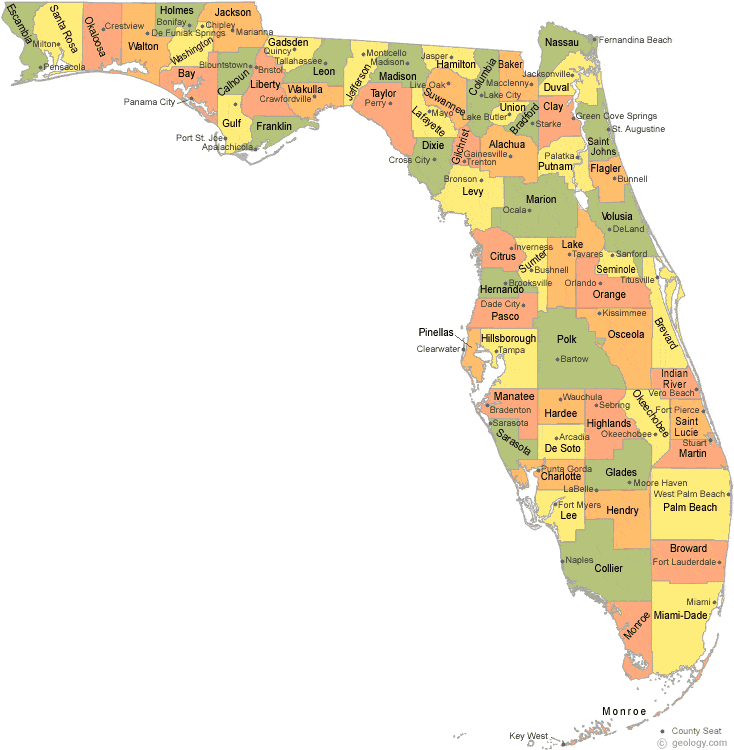
Florida's 67 counties are not created equal. The same statutory 18% maximum rate applies everywhere, but the effective yield you actually achieve is determined almost entirely by which county you bid in and what property types you target. The framework below treats Hillsborough County (Tampa) as the operational anchor and builds outward, balancing collateral quality, institutional competition, OTC opportunity, and geographic familiarity.
| Rank | County | Tier | Distance from Tampa | Collateral Quality | Competition | Effective Yield | OTC Opportunity | Strategic Notes |
|---|---|---|---|---|---|---|---|---|
| — | HillsboroughTampa / Brandon / Plant City | Tier 1 | Home Base | 1–4% | Low | Your home market — use for large improved residential and commercial liens where institutional 1–3% returns are acceptable as credit-like income. Avoid homestead bidding wars entirely. | ||
| 1 | PolkLakeland / Winter Haven | Tier 2 | ~45 min E | 6–12% | Moderate | Top pick. Florida's largest inland county by area. Rapid I-4 corridor growth drives strong collateral. Institutional bidders lighter than Tampa/Orlando. Mix of suburban residential, industrial, and agricultural — good certificate diversity. High redemption rate on improved properties. | ||
| 2 | PascoWesley Chapel / New Port Richey / Dade City | Tier 2 | ~30 min N | 7–13% | Moderate | Strongest growth trajectory near Tampa. Wesley Chapel is one of the fastest-growing suburbs in Florida — collateral appreciation is strong. Northern Pasco (Dade City, Zephyrhills) has less competition and meaningful OTC. Two distinct sub-markets within one county registration. | ||
| 3 | ManateeBradenton / Lakewood Ranch / Palmetto | Tier 2 | ~45 min S | 5–11% | Moderate | Excellent collateral quality — Lakewood Ranch is among the best-selling master-planned communities in the US. High median home values support large certificate face amounts. Moderate institutional presence. Strong redemption on improved residential. Focus on non-homestead rentals and small commercial. | ||
| 4 | SarasotaSarasota / Venice / North Port | Tier 2 | ~60 min S | 5–10% | Low–Mod | Affluent market with high property values — certificates carry large face amounts, improving capital efficiency. North Port submarket growing rapidly with more accessible certificate sizes. Competition moderate but less algorithmic than Tampa/Miami. Good collateral backstop even on non-redeemed positions. | ||
| 5 | HernandoSpring Hill / Brooksville / Weeki Wachee | Tier 3 | ~50 min N | 9–15% | High | Institutional bidders largely absent. Spring Hill is a large retirement-oriented suburban market with steady redemption on improved residential. Eastern Hernando has more rural/agricultural parcels — vet carefully. OTC channel is productive here. Avoid landlocked rural lots. Best county for individual investors seeking 10%+ blended yields near Tampa. | ||
| 6 | LakeClermont / Leesburg / Tavares | Tier 3 | ~75 min NE | 9–15% | High | Clermont submarket benefits from Orlando overspill growth — solid collateral on improved residential. Central and northern Lake County (Leesburg, Lady Lake, The Villages corridor) has large retirement community concentration with strong redemption motivation. Good OTC volume in rural townships. Less competitive than anything in the I-4 corridor. | ||
| 7 | CharlottePort Charlotte / Punta Gorda / Englewood | Tier 3 | ~90 min S | 10–16% | High | Heavily platted county — thousands of small residential lots from mid-century subdivision boom. Many lots are vacant and sub-economic; rigorous due diligence is essential. Improved residential and small commercial in Port Charlotte and Punta Gorda carry good collateral. Hurricane Ian (2022) impact on values requires parcel-level assessment. High OTC volume rewards diligent screeners. | ||
| 8 | MarionOcala / Silver Springs / Belleview | Tier 3 | ~90 min N | 10–16% | High | Ocala is a genuine mid-size city with stable real estate fundamentals — improved residential in Ocala proper carries solid collateral. Horse country estates (NW Marion) are high-value but illiquid. Rural and equestrian-zoned parcels need careful buildability analysis. Low institutional presence makes this a reliable high-yield source. Strong OTC pipeline. | ||
| 9 | HighlandsSebring / Avon Park / Lake Placid | Tier 4 | ~90 min SE | 12–18% | Very High | Inland agricultural county — minimal institutional competition, large OTC inventory. Sebring city core has reasonable improved residential collateral. Outside the city: agricultural parcels and older mobile-home communities with lower resale liquidity. Redemption rates lower than coastal counties. Yield is real but collateral vetting is non-negotiable. Maximum certificate size discipline required. | ||
| 10 | CitrusCrystal River / Inverness / Homosassa | Tier 4 | ~80 min N | 12–18% | Very High | Retirement and nature-tourism driven economy. Improved residential in Inverness and Crystal River has modest but stable collateral. Very large share of certificates go OTC — significant volume available at full 18%. High proportion of rural lots, mobile homes, and wetland-adjacent parcels require aggressive pre-bid screening. Treat as opportunistic/OTC-only allocation. | ||
| 11 | HardeeWauchula / Bowling Green / Zolfo Springs | Tier 4 | ~60 min SE | 14–18% | Very High | Highest yield, highest risk. Deeply rural agricultural county — citrus and cattle. Near-zero institutional presence; OTC inventory is large and largely untouched. Wauchula city core has some improved residential of value. The vast majority of certificates are on agricultural parcels and rural lots where resale market is extremely thin. Only deploy here for carefully vetted improved residential in Wauchula, and keep individual positions small. |
A Hillsborough-centered portfolio targeting blended 8–12% effective yield should allocate roughly: 15% to Hillsborough (surgical, large liens only) · 50% across Polk, Pasco, Manatee, and Sarasota (Tier 2 core) · 25% across Hernando, Lake, Charlotte, and Marion (Tier 3 yield) · 10% opportunistic OTC in Highlands and Citrus. Hardee and similar Tier 4 rural counties should only receive capital after you have established operational fluency in Tiers 2 and 3.
Purchasing the certificate is not the end of the work — it is the beginning of active portfolio management. Florida tax certificates require monitoring, record-keeping, and strategic decision-making to maximize returns and protect capital.
- Monthly: Review all certificates approaching the 22-month TDA eligibility window. Decide whether to file TDA or continue holding.
- Quarterly: Reconcile accrued interest across your portfolio. Identify any certificates approaching 7-year expiration. Review county tax rolls for subsequent-year delinquencies on your parcels.
- Annually (March–April): Decide whether to purchase subsequent-year certificates on non-redeemed parcels. Re-register on auction platforms. Allocate capital for the upcoming May/June auction season.
The core decision framework is not simply "which state has the highest rate" — it is matching the structural characteristics of each market to Lodestar Capital's specific objectives for each pool of capital deployed.
- Florida: 35–40% of total tax lien capital — core market, high familiarity, strong OTC/TDA infrastructure
- Arizona: 20–25% — excellent growth-state collateral, diversified auction timing (Feb/Mar), accessible online platform
- Texas: 15–20% — redeemable deed allocation for highest-penalty yield and property acquisition optionality
- Colorado: 10–15% — Q4 deployment window, premium-bidding dynamics, frontier market for sophisticated investors
- New Jersey: 5–10% — high-conviction, large-face lien opportunities only; legal complexity requires attorney partnership
| Resource | State | Purpose | Link | |||
|---|---|---|---|---|---|---|
| RealAuction | Florida | Primary online tax certificate auction platform used by many FL counties | realauction.com | |||
| BidInc | Florida | Third-party auction platform used by several FL counties | LienHub | Florida | Major statewide platform used by multiple FL counties for tax certificate auctions | lienhub.com |
| Miami-Dade Tax Collector | Florida | Miami-Dade County tax certificate sale registration and information | miamidade.gov/taxcollector | |||
| FL Dept. of Revenue — Property Tax | Florida | Florida property tax law, Chapter 197 statutes, county contact directory | floridarevenue.com/property | |||
| Florida DEP OCULUS | Florida | Environmental contamination, brownfield, and site cleanup records | oculus.dep.state.fl.us | |||
| FL DEP Storage Tank Locator | Florida | Search Underground Storage Tank (UST) registrations by address or parcel | floridadep.gov — Tank Locator | |||
| FEMA Flood Map Service Center | Federal | Look up FEMA flood zone designation (Zone A, AE, X, etc.) by address | msc.fema.gov | |||
| FWS Wetlands Mapper | Federal | National Wetlands Inventory — identify wetland parcels before bidding | fws.gov — Wetlands Mapper | |||
| EPA Cleanups in My Community | Federal | EPA Superfund, brownfield, and RCRA hazardous waste site search by location | epa.gov/cleanups | |||
| PACER — Federal Court Records | Federal | Search bankruptcy filings and IRS federal tax lien notices by property owner name | pacer.gov | |||
| Maricopa County Treasurer — Tax Lien | Arizona | Arizona's largest county tax lien auction registration and parcel search | treasurer.maricopa.gov | |||
| Arizona AZ Tax — State Lien Info | Arizona | Arizona Department of Revenue property tax information and lien statutes | azdor.gov/property-tax | |||
| Texas Tax Sale — Bid4Assets | Texas | Online platform for select Texas county tax deed sales (supplemental to live auctions) | bid4assets.com/taxsales | |||
| Texas Comptroller — Property Tax | Texas | Texas property tax code, redeemable deed statutes, and county appraisal district links | comptroller.texas.gov/taxes/property-tax | |||
| NJ Tax Sale Certificates — Bid4Assets | New Jersey | Online platform for New Jersey municipal tax certificate auctions | bid4assets.com/newjersey | |||
| Colorado Treasurer — Tax Lien | Colorado | Colorado state property tax information and county treasurer links for lien auctions | treasury.colorado.gov | |||
| El Paso County Treasurer — CO | Colorado | El Paso County (Colorado Springs) tax lien sale information and registration | treasurer.elpasoco.com |